
The biotope coefficient per surface (CBS) and the full earth coefficient do not treat green space on slabs in the same way. Confusing the two leads to calculation errors that block the processing of building permits. Understanding the weighting applied to each type of vegetated surface is a prerequisite for any development project on built land.
Weighting of green spaces on slabs in the biotope coefficient
A vegetated area in full earth receives an ecological value coefficient of 1. A green space on a slab never benefits from this equivalence.
The weighting varies according to the thickness of the substrate. A vegetated slab with at least 30 cm of topsoil is generally assigned a coefficient of 0.7. When the thickness falls below this threshold, the coefficient drops to 0.5, sometimes less depending on local regulations.
Several recent PLUs, notably those of Grand Lyon and the Eurometropolis of Strasbourg, have tightened the rules: simple planters or boxes no longer count at all towards the CBS. Only areas with continuous substrate and real infiltration capacity are taken into account. We observe that this trend has been generalizing since the Climate and Resilience Law of August 2021 and the local implementation of net zero artificialization objectives.
Before sizing your plantings, you must check in the zoning regulations of your PLU which weighting grid applies. Calculating the percentage of green space on slabs without knowing the local coefficient amounts to working on false assumptions.
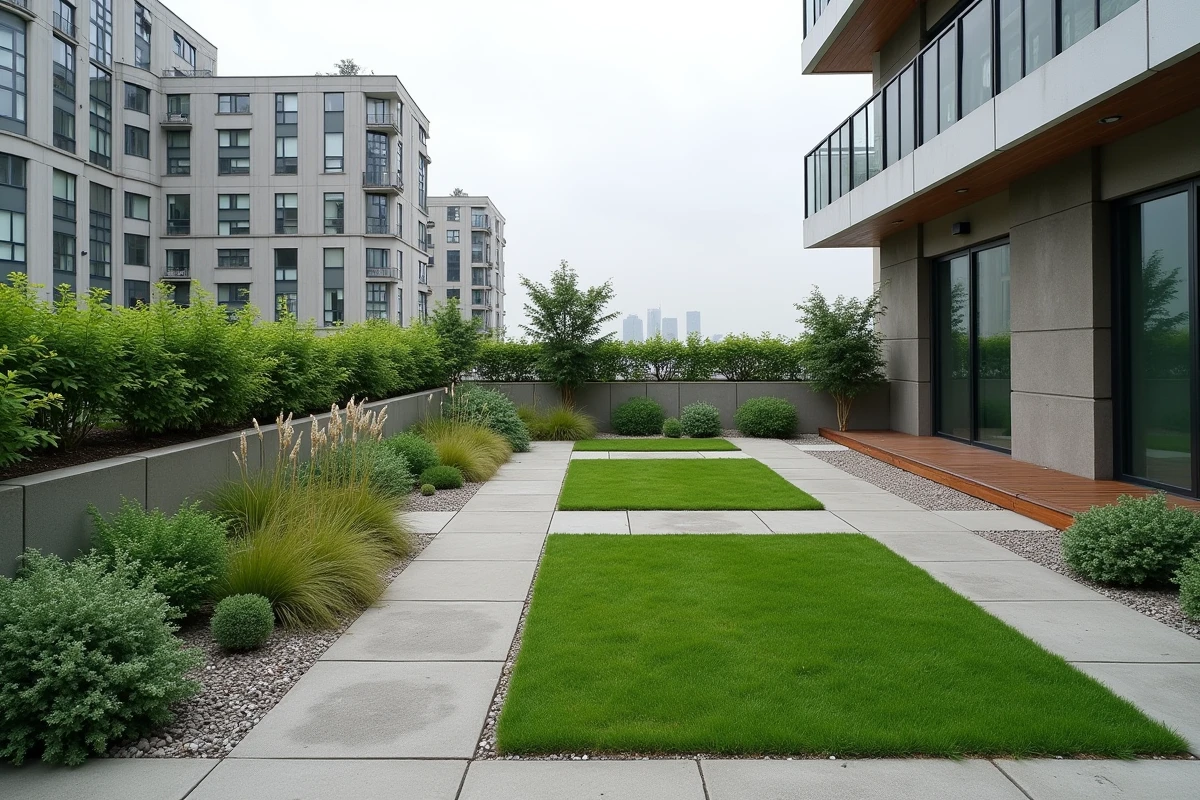
Cross-section and technical justification in the permit application
Since 2022-2023, several PLUs impose a requirement for justification by cross-section for any vegetated area on slabs. The plan must show the complete stratigraphy: waterproofing, drainage, filter layer, substrate, vegetative layer.
The thickness of the substrate is not enough. The instructing service also checks the continuity with the natural soil. A slab over an underground parking lot with a substrate greater than 80 cm and connection to the natural ground can be reclassified as nearly full earth in certain regulations. Without this continuity, the coefficient remains capped.
We recommend systematically providing a detailed calculation table of the CBS in the application file, even when the regulation does not formally require it. This table breaks down each type of surface with its weighting:
- Impermeable surfaces (concrete, asphalt, traditional roofing) multiplied by 0, thus contributing nothing to the coefficient
- Semi-open surfaces (gravel, wooden paving, stabilized, grass mesh) multiplied by 0.5
- Green spaces on slabs with a minimum of 30 cm of substrate, multiplied by 0.7
- Green spaces on slabs with less than 30 cm of substrate, multiplied by 0.5
- Full earth in direct relation to the layers of natural soil, multiplied by 1
The final result is the ratio between the sum of the weighted eco-developable surfaces and the total area of the plot.
Full earth coefficient or CBS: two calculation logics for the same plot
The full earth coefficient relates the area of non-impermeabilized natural soil to the total area of the land. It excludes by definition any surface on a slab, regardless of the thickness of the substrate. A plot entirely built on a slab has a full earth coefficient of zero, even with generous greening on the roof.
The CBS adopts a different logic. It incorporates all surfaces according to their weighted ecological value. It is this coefficient that allows for the valuation of green spaces on slabs in regulatory calculations.
The technical sheet from DRIEAT Île-de-France specifies that nearly 40% of municipalities in the Île-de-France region are subject to the obligation to impose a minimum share of non-impermeabilized or eco-developable surfaces, under Article L.151-22 of the Urban Planning Code. Depending on the wording of the regulation, either the full earth coefficient or the CBS applies.

Identify the correct coefficient in your zoning regulations
The PLU regulations of your municipality are included in the graphical and written documents available at the town hall or on the urban planning geoportal. Look for the section related to your zone (UA, UB, UC, etc.) and identify mentions of “full earth coefficient,” “biotope coefficient,” or “minimum share of eco-developable surfaces.”
If the regulation mentions a percentage of green spaces without specifying the method, contact the municipality’s urban planning service before submitting your permit. Interpretation may vary from one instructor to another, and a reading error can lead to a request for additional documents that delays processing.
Vegetation density and substrate: what really changes the percentage
On a project for a vegetated slab above a parking lot, the common reflex is to maximize the planted area. This is insufficient if the substrate depth does not meet the regulation threshold.
A substrate that is too thin limits water retention and root capacity, which reduces the actual ecological value of the development. Communities that apply the CBS weigh accordingly: the thickness of the substrate determines the coefficient, not just the planted area.
Projects aiming for a high coefficient on slabs must balance the admissible structural load (a thick substrate is heavy) and the weighting gain. A structural engineering firm must validate the load-bearing capacity of the slab before the landscape architect sizes the substrate.
- Substrate less than 30 cm: coefficient generally capped at 0.5, suitable for sedums and low grasses
- Substrate between 30 and 80 cm: coefficient of 0.7 in most CBS, compatible with shrubs and perennials
- Substrate greater than 80 cm with continuity to natural soil: possible reclassification as nearly full earth according to local PLU
The choice of substrate also conditions the type of vegetation allowed, which directly influences compliance with the landscaping aspect of the building permit. A planting plan inconsistent with the declared thickness will be noted by the instructor.
The regulatory trend pushes for increasing requirements for thickness and hydric continuity with the soil. Anticipating future revisions of the PLU during design avoids costly revisions in the medium term.