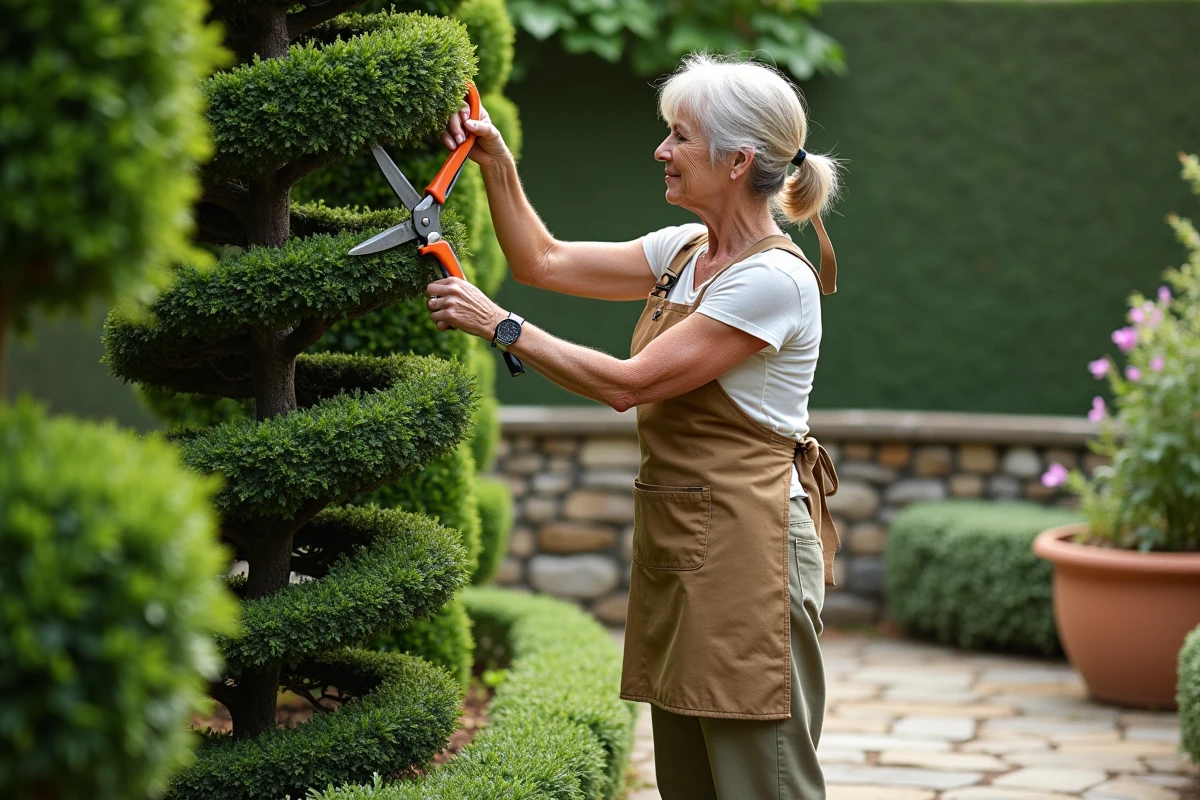
Vegetal sculpture applied to hedges is not just about using a hedge trimmer at a constant height. Working a hedge in volume requires a fine understanding of the natural growth habit of each species, a pruning schedule aligned with phenology, and a training strategy that spans several years. Here, we address the technical points that general public guides often overlook.
Water stress and hedge sculpture: adapting species to the current climate
The prolonged drought episodes observed in recent years are profoundly altering the list of viable species for sculpture. A hedge severely pruned during periods of water stress heals poorly, and the regrowth lacks density the following spring.
Buxus, a historical reference for topiary art, faces two disadvantages: sensitivity to box tree moth and regular water needs to maintain compact foliage after pruning. In regions where summer rainfall has significantly decreased, we recommend preferring yew (Taxus baccata) or Japanese privet (Ligustrum japonicum), which tolerate dry soils better while accepting architectural pruning.
Beech (Fagus sylvatica) is an interesting alternative for tall sculpted hedges. Its marcescent foliage remains in place during winter, preserving the visual volume of the sculpture even off-season. However, its slower growth requires a training plan over three to five years before achieving sufficient volume to work with complex shapes.
To delve deeper into the characteristics of each pruning tool suitable for these species, sculpte-haie.com details the technical criteria that guide the choice between single blade and double action blade depending on the hardness of the wood.
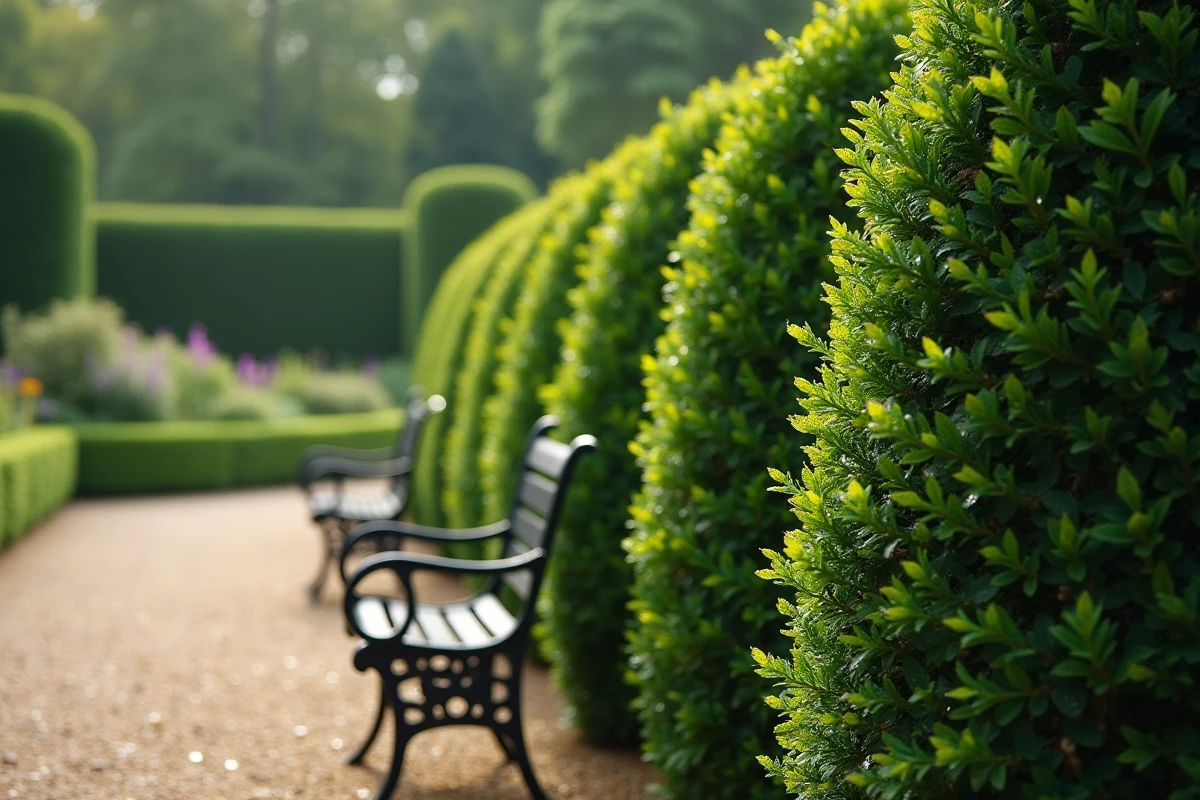
Pruning windows and phenology: when to sculpt without weakening the hedge
Vegetal sculpture requires at least two pruning sessions per year, compared to just one for a free-form hedge. The schedule must respect the growth cycles specific to each species, or it risks compromising foliage density.
- For fast-growing evergreens (privet, cherry laurel), the first pruning occurs after the first wave of spring growth, usually between late May and mid-June. The second is scheduled in September, before the vegetative slowdown.
- For yew and boxwood, the main pruning is done in June, when the new shoots have reached their nearly final length. A light refresh in late summer is enough to maintain the shape.
- Beech is pruned in August: this late window allows the marcescent foliage to settle properly and remain attached throughout winter, preserving the sculpted silhouette.
- Spring-flowering species (hawthorn, spiraea) are only pruned after flowering, which limits their use in formal sculpture but opens possibilities in free sculpted hedges with asymmetrical volumes.
Pruning too early in spring means removing flower buds and causing chaotic regrowth. Pruning too late in autumn exposes young shoots to frost. The optimal window is always after the end of sap flow, never during.
Asymmetrical sculpture and contemporary forms on country hedges
The trend towards minimalist or asymmetrical sculpture is gaining ground in contemporary gardens. The idea is to break away from the straight-edged hedge to create undulating volumes, irregular crests, or windows cut into the plant mass.
This approach works particularly well on mixed country hedges. Rather than imposing a uniform geometric shape on species with naturally different growth habits, each shrub is worked according to its own potential. A hornbeam lends itself to rounded volumes, a holly to conical shapes, and a dogwood to spreading silhouettes.
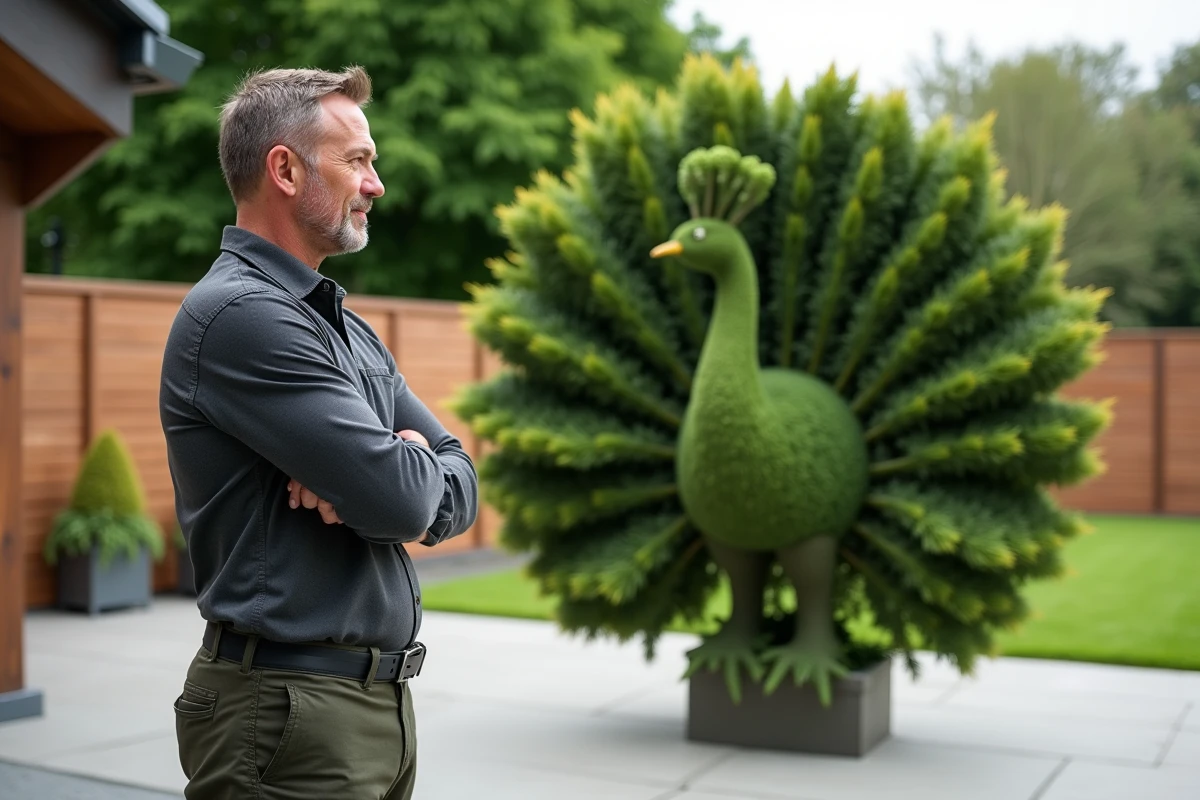
The key lies in managing depth planes. The subjects in the foreground are pruned lower and tighter, while those in the background retain more height and freedom. The result evokes a relief landscape rather than a flat green wall.
For precise geometric shapes (battlements, regular waves), a physical template made of wire remains the most reliable method. We fix it directly onto the hedge with stakes, and it serves as a cutting guide for two or three seasons, until the shape settles into the woody structure.
Common mistake with mixed hedges
Sculpting a hedge composed of several species as if it were a single one produces an inconsistent result. Each species has a different growth rhythm, and a uniform cut creates visible discrepancies within weeks. It is essential to work on the hedge species by species, with distinct cutting adjustments.
Annual maintenance of a sculpted hedge: anticipating the workload
A sculpted hedge requires a significantly higher time investment than a traditionally pruned hedge. The frequency of maintenance directly affects the sharpness of the shapes: a minimum of two sessions, three for vigorous species like privet or laurel.
Beyond pruning, fertilization plays a often underestimated role. A sculpted hedge undergoes significant biomass removal. Adding compost at the base each autumn, complemented by organic mulching, helps compensate for exports and maintain a living soil around the roots.
Watering is another critical variable, especially during the first two years after severe formative pruning. A heavily cut shrub to create a shape needs moist soil to regenerate its foliage. In the absence of rain, watering at the base (not by spraying) every two weeks between June and September prevents thinning.
It’s better to have a simple well-maintained shape than an ambitious sculpture that deteriorates due to lack of regular care. We observe that the most successful hedges in the long term are those whose complexity remains proportionate to the time the gardener can realistically dedicate to them each year.