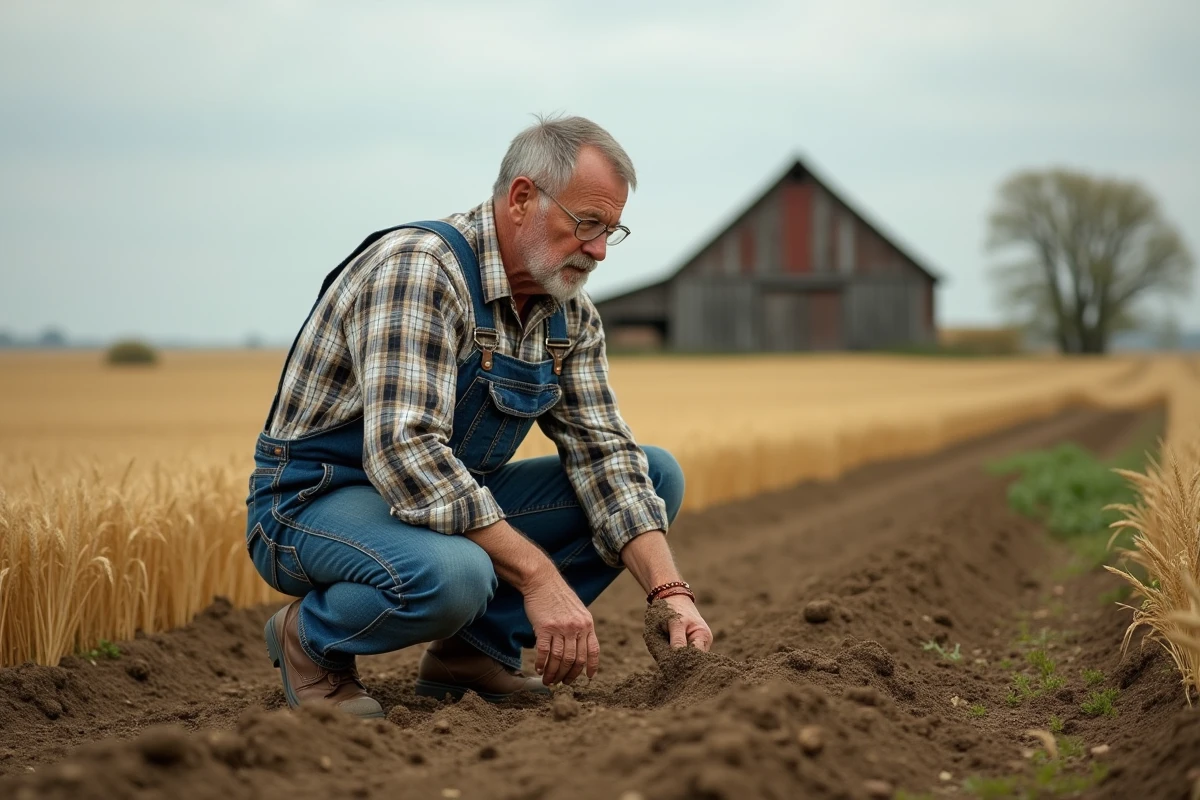
A hailstorm on a wheat field in full growth, a fire starting from a storage shed in summer, an irrigation pipe bursting and flooding the technical room: on agricultural land, disasters do not give warning. Agricultural multi-risk insurance brings together in a single contract the guarantees that cover buildings, equipment, crops, and liability.
Understanding how these guarantees are structured, especially since the 2023 reform on climate risks, allows for tailoring protection closely to the operation.
Shrink-swell of clays and climate hazards: two underestimated risks on agricultural land
When discussing agricultural disasters, people first think of hail or storms. The shrink-swell of clays, however, is gaining attention in insurers’ analysis grids without many operators being concerned. This phenomenon cracks farm buildings, distorts irrigation structures, and can render a shed unusable within a few months.
Since the extension of the Cat Nat drought regime (finance law for 2022, specified by several decrees between 2022 and 2024), insurers increasingly require preventive measures: appropriate drainage, management of vegetation around foundations, maintenance of buried pipes. A clay-rich area without documented prevention risks a denial of compensation.
Taking out a multi-risk insurance for agricultural land requires formalizing these precautions, which protects both the land value and the production tool. Feedback on this point varies by department and soil type, but the trend is clear: no prevention, no comprehensive coverage.
Climate guarantees and the 2023 reform: what changes in the multi-risk contract
The reform of crop insurance, which came into effect on January 1, 2023 (law n°2022-298 of March 2, 2022, and ordinance n°2022-1119 of August 4, 2022), has redesigned how guarantees are structured for agricultural land exposed to climate hazards. The principle is based on three tiers.
- The operator absorbs minor losses, below a defined trigger threshold in the contract.
- The private insurer covers intermediate losses, with premiums partially subsidized by the state to encourage subscription.
- Beyond a certain level of loss, public reinsurance (CCR) intervenes as a supplement, which limits the risk borne by the insurer and stabilizes the cost of the contract.
This interplay between private guarantee and public scheme reduces the out-of-pocket expenses for the operator in the event of major climate disasters. Before 2023, an episode of intense drought could leave the farmer alone in facing yield loss if their contract did not specifically cover the crops.
Premium subsidies: a concrete lever
The new system provides for partial coverage of crop insurance premiums. For an operator hesitant about the cost of the contract, this subsidy changes the equation. It shifts from an expense perceived as an additional cost to an investment partially funded by public risk management funds.
Integrating crop guarantee into the multi-risk contract (rather than in a separate contract) simplifies administrative management. One point of contact, one claim declaration, one compensation schedule.
Single contract or separate guarantees: why bundling offers better protection
A shed fire is almost never an isolated disaster. The fire destroys the building, the equipment stored inside, sometimes the harvested crops, and can engage the operator’s civil liability if the flames spread to a neighbor. With separate contracts, each insurer manages its own scope. Delays increase, deductibles accumulate, and gray areas between two contracts lead to denial of compensation.
The agricultural multi-risk contract covers buildings, contents, equipment, and civil liability within a single framework. The operator declares a single claim. The insurer assesses all damages and applies a global deductible, not a deductible per item.
Civil liability: the guarantee that is forgotten until the day of the disaster
The professional civil liability included in the multi-risk contract covers damages caused to third parties due to agricultural activity. A machine damaging a neighboring fence, a pesticide treatment drifting onto an adjacent organic plot, an animal escaping and causing an accident: these situations financially engage the operator.
Without civil liability, a single incident with a third party can cost more than several years of premiums. The multi-risk contract includes this basic guarantee, often with options to extend it (legal protection, liability related to self-propelled machinery).

Adapting guarantees to the land: modulate rather than overdimension
A cereal farmer in Beauce and a vineyard owner on hillsides do not have the same exposures. The former fears hail on large flat areas, while the latter dreads spring frost on sloped plots. A good multi-risk contract is calibrated to the actual activity, not based on a standard model.
Most insurers offer adjustable deductibles. Increasing the deductible on a low-risk (theft in a low-exposure area, for example) allows for reducing the overall premium and concentrating the budget on climate or fire guarantees, where the risk is significant.
- Check that the electrical damage guarantee covers automated irrigation equipment, often excluded from basic plans.
- Ensure that crops stored outside buildings (silage outdoors, hay bales under tarps) are included in the coverage.
- Review the hay heating clause, a frequent cause of fire in livestock operations, sometimes subject to specific storage conditions.
Each year, reviewing the specific conditions of the contract takes an hour. Failing to do so risks discovering an exclusion on the day a claim is filed.
On agricultural land, the value of exposed assets evolves with the seasons, investments, and crop rotations. Updating the contract with each significant change avoids discrepancies between coverage and the reality of the operation.