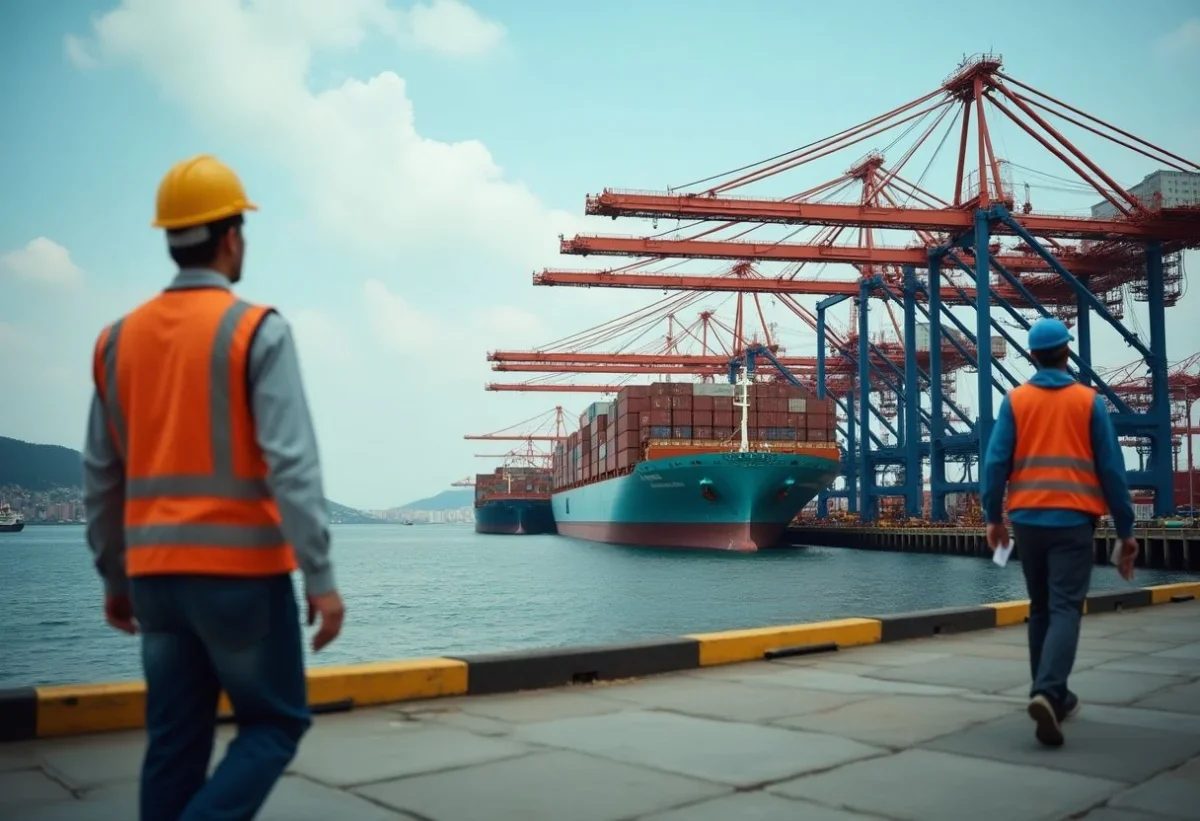
International transport is at the crossroads of global economic exchanges, transcending borders and cultures to connect markets and individuals. In the era of globalization, it has become more than ever a fundamental pillar for global economic development. Maritime routes, airways, and railways weave together a complex web that allows for the smooth flow of goods. This global infrastructure relies on technological and logistical advancements that constantly challenge the limits of efficiency and security.
The historical evolution of international transport
Understanding the present requires looking back at the historical evolution of international transport. From the caravans of the Silk Road to the steamships of the 19th century, each era has transformed the methods and means of transport.
- Caravans and ancient trade routes : The trade routes of antiquity, such as the Silk Road, laid the foundations for large-scale trade exchanges, connecting Asia to Europe.
- Industrial Revolution : The invention of the steamship and the railway revolutionized transport, significantly reducing delivery times and costs.
- Technological advancements : The emergence of commercial aviation and the development of shipping containers in the 20th century enabled an unprecedented interconnection of global markets.
Modes of transport in international trade
International trade relies on a variety of transport modes, each playing a specific role in the logistics chain. These means complement and compete with each other in a quest for ever-renewed efficiency.
- Maritime transport : Dominating the volume of global trade, maritime transport accounts for about 90% of exchanges. It is essential for heavy and bulky goods.
- Air transport : Fast but costly, this mode is favored for high-value or perishable goods, reducing delivery times on an international scale.
- Rail transport : Offering a compromise between volume and speed, rail is an eco-friendly option for the overland transport of goods over long distances.
- Road transport : Essential for the last mile, road transport ensures the distribution of goods from ports and airports to end consumers.
Challenges and innovations in the transport sector
As global trade grows, the transport sector must innovate to meet new challenges. Between green initiatives and the adoption of cutting-edge technologies, the sector is constantly reinventing itself.
- Environmental sustainability : The pressure to reduce carbon emissions is pushing companies to adopt greener technologies and alternative fuels.
- Technology and digitalization : From automation to the use of artificial intelligence, digitalization is transforming logistics operations for greater precision and efficiency.
- Infrastructure and capacity : Modernizing existing infrastructure and expanding port capacities are crucial to support the growth of international trade.
Impact of international transport on global economies
The international transport is the engine of economic globalization, enabling the flow of goods, services, and capital on an unprecedented scale. Its influence on national and local economies is undeniable.
- Job creation : The transport industry employs millions of people worldwide, generating economic opportunities for many communities.
- The balance of trade : Exporting countries rely on international transport to balance their trade, thus influencing their overall economic growth.