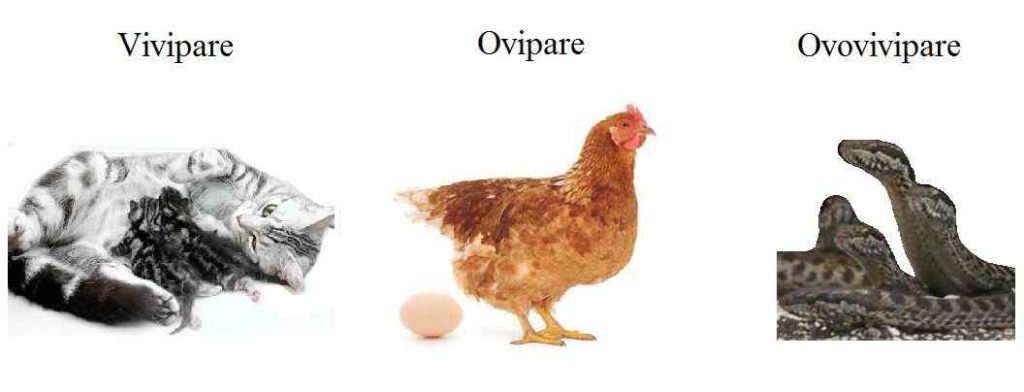
Content of the article
- What is the difference between Viviparous, Oviparous, and Ovoviviparous?
- Mnemonic medium:
- Some examples:
- Tips for snakes:
What is the difference between Viviparous, Oviparous, and Ovoviviparous?
The goal of this article is to understand how to differentiate the different modes of reproduction (which are three) in animals, and to see some examples of species grouped by mode of reproduction.
Here are the three different modes of reproduction:
Oviparous lay eggs; the growth of the embryo occurs outside the maternal organism during incubation (embryonic development in the egg).
Viviparous give birth to fully formed young; they develop in the mother’s uterus and are nourished by the umbilical cord.
Ovoviviparous give birth to fully formed young, which are nourished and developed in eggs that hatch inside the female, so there is no umbilical cord between the female and the embryo.
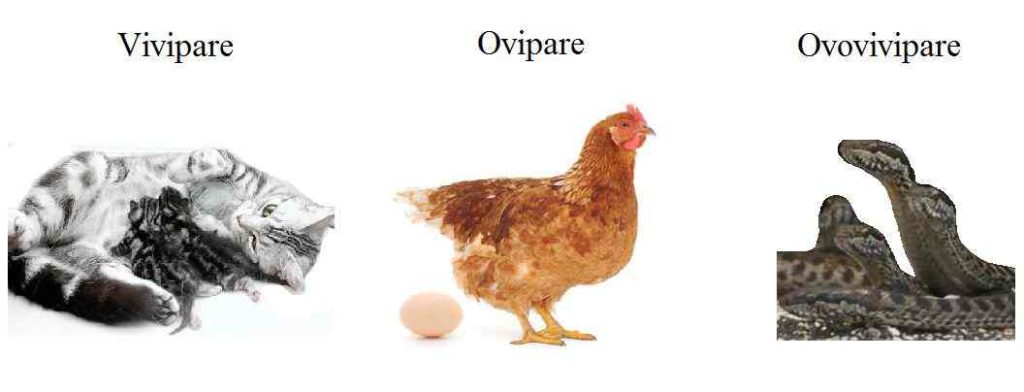
Mnemonic medium:
To remember that oviparouslay eggs, just make the analogy between the o in oviparous and the o shape of an egg. Conversely, there is no o in viviparous, so viviparous species give birth to fully formed young.
Some examples:
Viviparous:
Almost all mammals are viviparous (felines, canids, cetaceans, bovids, deer, camelids, etc.).
Oviparous:
The two exceptions among mammals are the platypus and the echidna: they nurse, but also lay eggs, they are the only mammals that are oviparous.
All species of birds, turtles, and crocodilians (crocodiles, alligators, caimans), and most fish and insects are oviparous.
Note: Squamates (lizards and snakes) can be oviparous or ovoviviparous.
The main oviparous lizards are:
- Madagascar gecko, which is a climbing lizard.
- Iguanas and monitor lizards.
The main oviparous snakes are:
- The python, the female lays eggs and then protects them by wrapping around them.
- The cobra, the female lays eggs but leaves the nest before hatching to avoid eating her own offspring (it is an ophiophagous snake, which feeds on snakes).
- The black mamba (the most venomous snake in Africa) lays eggs, and the young are green at birth (unlike the gray adults).
- Coluber, a non-venomous snake.
- Taipan, a venomous snake in Australia.
Ovoviviparous:
Some squamates (lizards and snakes) are ovoviviparous:
The ovoviviparous lizards are the blue skink, slow worm, and the Jackson’s chameleon.
The ovoviviparous snakes are:
- The viper, a very venomous snake. Once the vipers are out of the mother’s body, they are already independent and have venom fangs.
- Coronella smooth, a non-venomous snake.
- The rattlesnake, some species of which have a rattle on the tail.
- Anaconda and boa, two constrictor snakes.
Note: We have not talked about sharks, but these cartilaginous fish have three modes of reproduction, because each species of shark is different, and this difference can lead to a change in mode of reproduction, for example:
- bull shark, hammerhead shark, and blue shark are viviparous.
- The dogfish and the carpet shark are oviparous.
- The tiger shark, the saw shark, and the great white shark are ovoviviparous.
Tips for snakes:
The following tip is to group in a table the 10 snakes seen in the article, on one side the oviparous and on the other the ovoviviparous snakes.
| Oviparous | Ovoviviparous |
| Cobra | Rattlesnake |
| Coluber | Viper |
| Python | Smooth Coronella |
| Black Mamba | Anaconda |
| Taipan | Boa |
In the table, we place the coluber and the viper opposite each other because these two snakes look alike, but are always distinguishable:
The coluber (non-venomous and oviparous) has large scales on its head, a single row of scales between the eye and the mouth, a round pupil, a rounded nose, a long tail, and when moving in a straight line, its body remains quite straight. The coluber has the same characteristics as the smooth coronella, but is ovoviviparous.
The viper (venomous and ovoviviparous) has small scales on its head, several rows of scales between the eye and the mouth, a vertical pupil, a pointed nose facing upwards, a short tail, and when it moves in a straight line, its body is wavy.
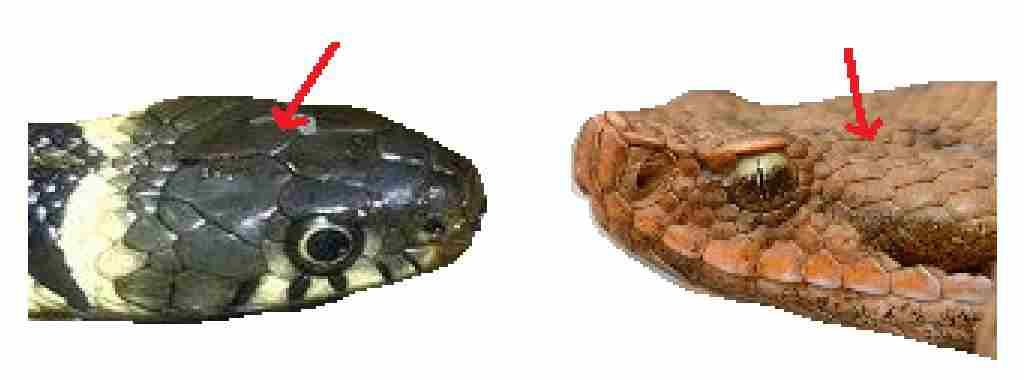
Additional small tip: To remember that the coluber is oviparous, one can think of the sound between the eyes and other things. Coluber (left), viper (right)
Tag: what is a viviparous